
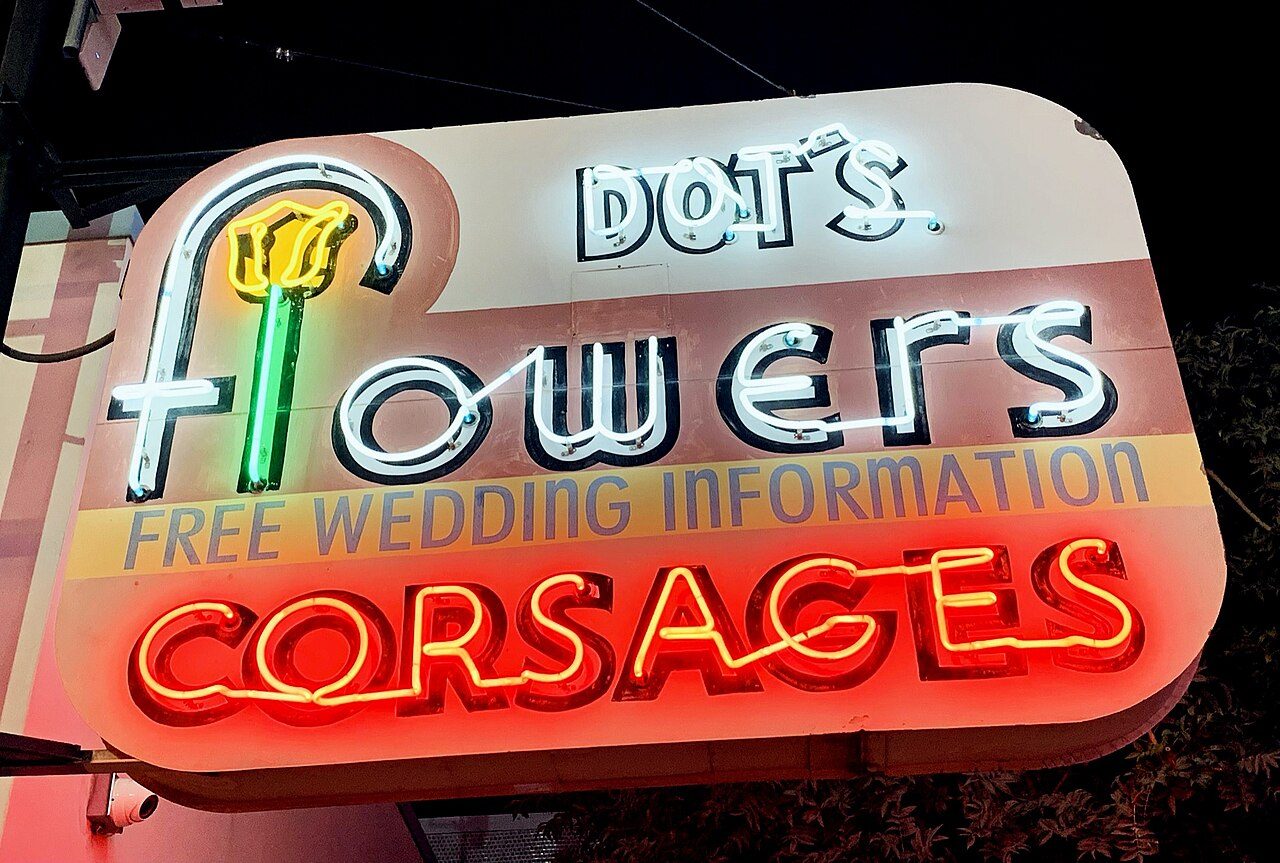

Las Vegas did not invent the neon sign, but no other city leaned on it so hard. For about half a century, the light on a casino's front was its advertising, its architecture and its argument with the neighbors, all at once. Signs grew taller, wider and busier because the place next door had just done the same.
Most of that glass is gone from the street now. LED screens do the work, and many of the old signs were taken down, crated and trucked to a lot north of downtown. Some of them have been relit, a few still hang where they always did, and the story of how they were made is better documented than you might expect.
Downtown and the sign companies
Nevada legalized wide-open gambling in 1931, and the clubs on Fremont Street, the railroad town's main street, needed a way to pull people in off the sidewalk. Electric signs were the answer. Thomas Young, a sign painter who had started his own company in Utah in 1920, began working in Las Vegas in the early 1930s; sources differ on whether his first branch opened in 1932 or 1933. His firm, later known as the Young Electric Sign Company, or YESCO, made one of its first big Las Vegas marks with a towering sign for the Boulder Club. One account puts a small Young neon sign in the window of the Oasis Club on Fremont as early as about 1929, but that date rests on a single source.
YESCO was never alone. Western Neon (also called Western Electric Displays) built the 'Welcome to Fabulous Las Vegas' sign in 1959 before YESCO bought the company in the early 1960s, and Ad Art, a California firm, designed and built some of the most famous Strip signs of the 1960s and later. Much of the city's visual identity came out of a few drafting rooms where staff designers competed for the same casino clients.
Fremont Street becomes Glitter Gulch
By the 1940s the packed blocks of downtown had earned the nickname Glitter Gulch. The Golden Nugget opened in 1946, and by the 1950s it had wrapped its upper floors in neon and bulbs; its large sign at Fremont and Casino Center stood until a 1984 renovation. In 1951 the Pioneer Club put up Vegas Vic, a 40-foot (12 m) waving cowboy, and he became the street's mascot.
Downtown signs had to work at walking pace and at close range, so they tended toward characters, animation and dense borders of chasing bulbs rather than sheer height. The canyon effect, with sign after sign facing each other across a narrow street, is what made Glitter Gulch photograph so well.




Roadside spectaculars on the Strip
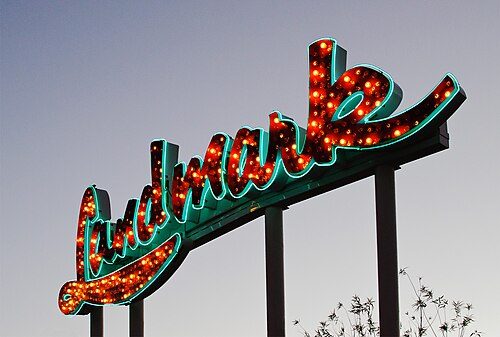
South of the city limits, the resorts along the Los Angeles highway faced a different problem. El Rancho Vegas opened in 1941 and the Flamingo in 1946, set back from a fast road with open desert behind them. Their signs had to catch a driver's eye from a long way off, so they grew into freestanding towers, the so-called spectaculars.
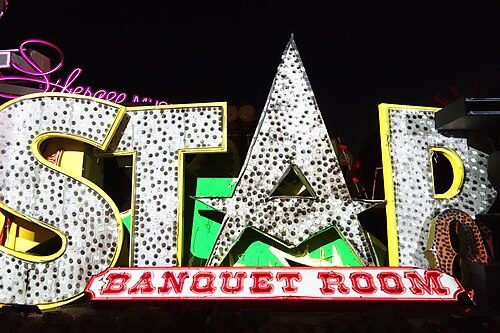
The Stardust took this furthest. When it opened in 1958, its façade sign, designed by Kermit Wayne, ran about 216 feet (66 m) along the building and carried roughly 11,000 bulbs and more than 7,000 feet of neon tubing around a model Earth and scattered planets. In 1968 it added a 188-foot (57 m) roadside pylon designed by Paul Miller of Ad Art. Signs like these were less like advertising boards than like buildings in their own right, and by the late 1960s the sign was often more memorable than the hotel behind it.
The designers
Sign designers worked for the sign companies, not the casinos, and many were barely credited at the time. A few names are now well documented. Betty Willis, a Western Neon designer born in Overton, Nevada, drew the 'Welcome to Fabulous Las Vegas' sign in 1959 and never copyrighted it; she also designed signs for the Moulin Rouge, the city's first racially integrated casino, and the Blue Angel motel. She died in 2015.
At YESCO, Pat Denner is credited with Vegas Vic (1951), Kermit Wayne with the 1958 Stardust façade, and Jack Larsen Sr. with the Silver Slipper's spinning shoe. At Ad Art, Paul Miller designed the 1968 Stardust pylon and Charles Barnard designed Vegas Vickie, the kicking cowgirl who went up across Fremont Street from Vic in 1980.
How neon works, and how it differs from bulbs and LED
A neon sign is a gas-discharge lamp. A craftsman heats straight glass tubing and bends it by hand into letters or outlines, fuses an electrode into each end, pumps out the air and fills the tube with a small amount of gas at low pressure. A transformer then pushes a high voltage through the gas, which glows. Pure neon gives the familiar red-orange; other colors come from other gases, such as argon, and from phosphor powders coated on the inside of the glass. The French inventor Georges Claude demonstrated neon lighting in Paris in 1910, and neon signs reached the United States in 1923, when a Los Angeles car dealer bought two reading 'Packard'.
Many classic Las Vegas signs mix neon with rows of incandescent bulbs. Neon draws lines and lettering; bulbs, switched on and off in sequence by flasher mechanisms, create the chasing, twinkling borders. LED modules, which became the standard for new signs in the 2000s, use far less power and can show video, but they light a surface rather than a line, which is why an LED sign rarely looks like the old glass even when it copies the shape.
Screens and the Fremont Street canopy
Downtown's answer to the megaresorts of the 1990s was to roof over its main street. Five blocks of Fremont Street closed to cars in September 1994, and on December 14, 1995, the Fremont Street Experience canopy switched on, with about 2.1 million incandescent bulbs in a vault roughly 1,375 feet (419 m) long and 90 feet (27 m) high. The canopy was rebuilt with LEDs in 2004 and again in 2019, when the Viva Vision screen gained more than 49 million LEDs.
The canopy, built by YESCO, was a sign of the times in both senses. During construction, part of Vegas Vic's hat brim was cut back to make room. Along the Strip, resorts switched to giant LED marquees, and the neon signs that came down usually went back to the sign companies, which typically leased signs to casinos rather than selling them outright.
Preservation and the Neon Museum
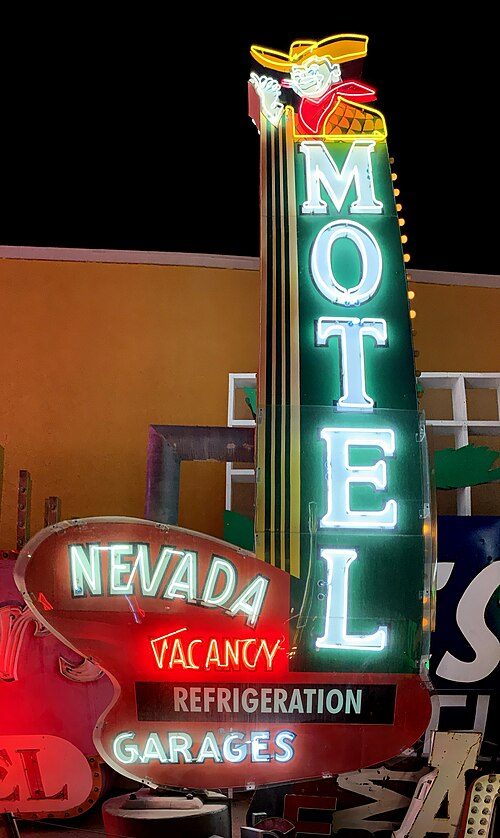
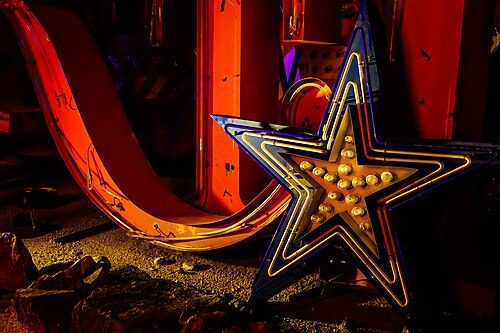
Retired signs once piled up in YESCO's yard. In the 1990s a group of local arts advocates began collecting them, and in November 1996 the newly funded Neon Museum relit its first restoration, the Hacienda's Horse and Rider, at Las Vegas Boulevard and Fremont Street. YESCO began transferring signs to the museum's lot, the Neon Boneyard, in 2001. The museum moved the shell-shaped La Concha Motel lobby from the Strip in 2006 to serve as its visitor center and opened to the general public on October 27, 2012.
Today the museum shows more than 250 unrestored signs in its outdoor Boneyard, plus restored and relit pieces such as the Stardust letters. It has also placed restored signs, among them the Silver Slipper, on medians along Las Vegas Boulevard, where they light up for free every night. Since 2024 it has been planning a move to a larger downtown site; as of 2026 the new location had not been settled, so check neonmuseum.org for the latest.
Eight signs and places to see
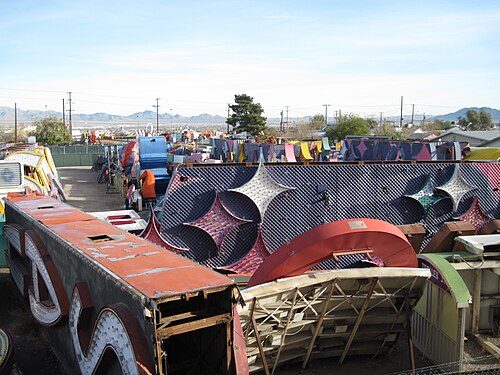 Founded 1996; open to the general public since 2012The Neon Museum and Neon BoneyardA nonprofit museum on Las Vegas Boulevard North, about a mile north of Fremont Street, with tours booked through its official site.
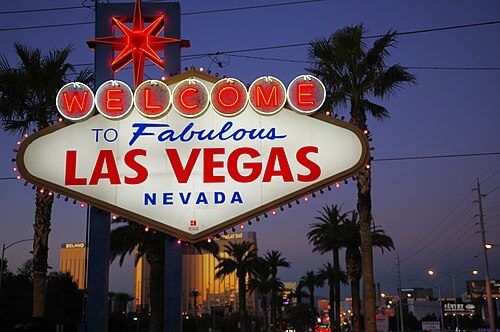 1959'Welcome to Fabulous Las Vegas' signStill in place in the median of Las Vegas Boulevard South, with a small parking lot for visitors.
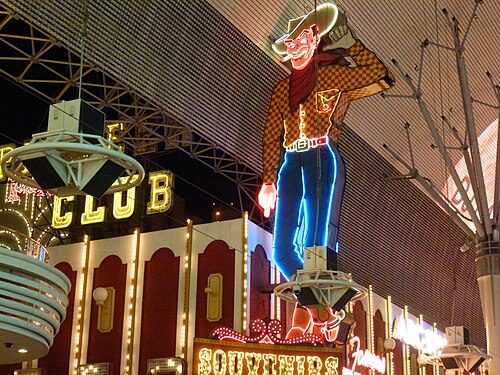 1951Vegas VicStill mounted on the former Pioneer Club building under the Fremont Street Experience canopy, though his arm no longer waves.
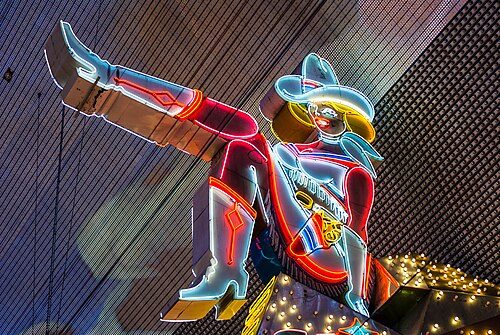 1980Vegas VickieRestored and installed inside Circa Resort & Casino, above the lounge that carries her name.
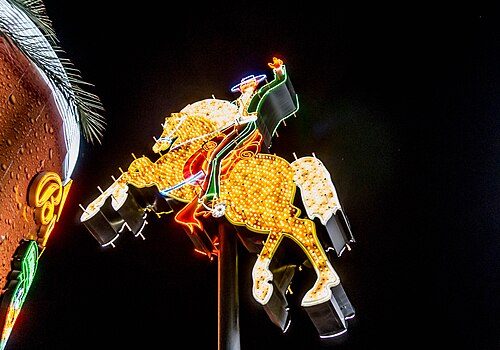 1967Hacienda Horse and RiderRestored and lit nightly on Las Vegas Boulevard at the Fremont Street intersection, as part of the Neon Museum's outdoor signs.
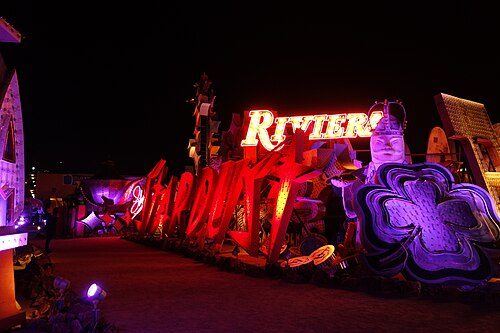 1958 (façade sign); 1968 (roadside pylon)The Stardust signsThe pylon's original letters stand relit in the Neon Museum's Boneyard; Resorts World occupies the old Stardust site.
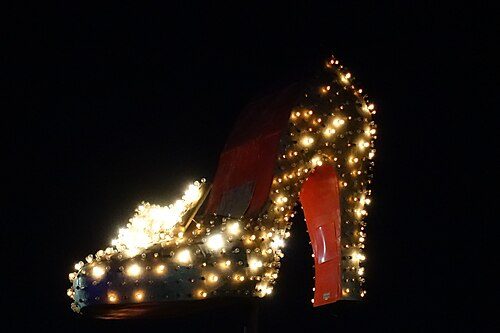 Mid-1950sSilver Slipper signRestored and lit in the median of Las Vegas Boulevard North, just west of the Neon Museum.
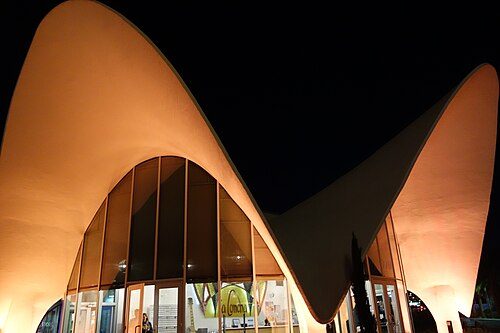 1961La Concha Motel lobbyRebuilt on the Neon Museum campus, where it serves as the visitor center and ticket lobby.
Timeline
- 1910Georges Claude demonstrates neon lighting in Paris.
- 1920Thomas Young starts the sign company that becomes YESCO.
- 1923Neon signs arrive in the US: two 'Packard' signs for a Los Angeles car dealer.
- c. 1929By one account, a Young neon sign appears in the window of the Oasis Club on Fremont Street. uncertain
- 1931Nevada legalizes wide-open gambling; Fremont Street clubs multiply.
- 1932 or 1933YESCO begins working in Las Vegas (sources differ on the year). uncertain
- 1941El Rancho Vegas opens on the highway south of town, the first resort on what becomes the Strip.
- 1946The Golden Nugget opens downtown and the Flamingo opens on the Strip.
- 1951Vegas Vic goes up on the Pioneer Club.
- 1958The Stardust opens with a façade sign about 216 feet long.
- 1959The 'Welcome to Fabulous Las Vegas' sign, designed by Betty Willis, is installed.
- 1968The Stardust's 188-foot roadside pylon, by Paul Miller of Ad Art, is installed.
- 1980Vegas Vickie, designed by Charles Barnard, appears across Fremont Street from Vic.
- 1995The Fremont Street Experience canopy opens on December 14.
- 1996The Neon Museum relights its first restored sign, the Hacienda Horse and Rider.
- 2006The La Concha Motel lobby is moved to the museum site; the Stardust closes.
- 2009The Welcome sign is listed on the National Register of Historic Places; restored signs go up along Las Vegas Boulevard.
- 2012The Neon Museum opens to the general public on October 27.
- 2019The Fremont Street canopy is rebuilt with more than 49 million LEDs, unveiled December 31.
- 2024The Mirage closes and its signage is donated to the Neon Museum; the museum announces plans to relocate.
Sources
- The Neon Museum (official site)
- The Neon Museum: Neon Boneyard
- The Neon Museum: Las Vegas Boulevard Scenic Byway project
- The Neon Museum: Stardust sign
- Las Vegas Advisor: When did neon arrive on the scene?
- NBC News: Betty Willis, designer of 'Welcome to Fabulous Las Vegas' sign, dies (2015)
- KNPR: The ballad of the neon cowgirl (2020)
- KSNV News 3: Stardust sign partially restored (2020)
- Wikipedia: Neon Museum
- Wikipedia: YESCO
- Wikipedia: Neon sign
- Wikipedia: Fremont Street Experience
- Wikipedia: Stardust Resort and Casino
- Wikipedia: Golden Nugget Las Vegas
Uncertain or disputed
- The c. 1929 Oasis Club neon sign rests on a single source (Las Vegas Advisor).
- YESCO's arrival in Las Vegas: sources give 1932 and 1933, and YESCO's own timelines also cite 1945 for a branch office.
- Kermit Wayne is credited with the Golden Nugget's 1950s neon façade by one source; the text names him only for the 1958 Stardust façade.
- Ad Art is described as a California firm; its exact base (Stockton is reported) is not stated.
- YESCO buying Western Neon in the early 1960s is from Wikipedia only.
- The canopy's construction cutting Vegas Vic's hat brim is reported by Wikipedia and secondary sources; no primary source was checked.
- Betty Willis's birth year is given as 1923 by some sources and 1924 by others, so it is omitted.
- Neon Museum relocation: announced 2024 for the Arts District, that plan dropped in 2025, other downtown sites under consideration; no confirmed new site as of October 2026.