
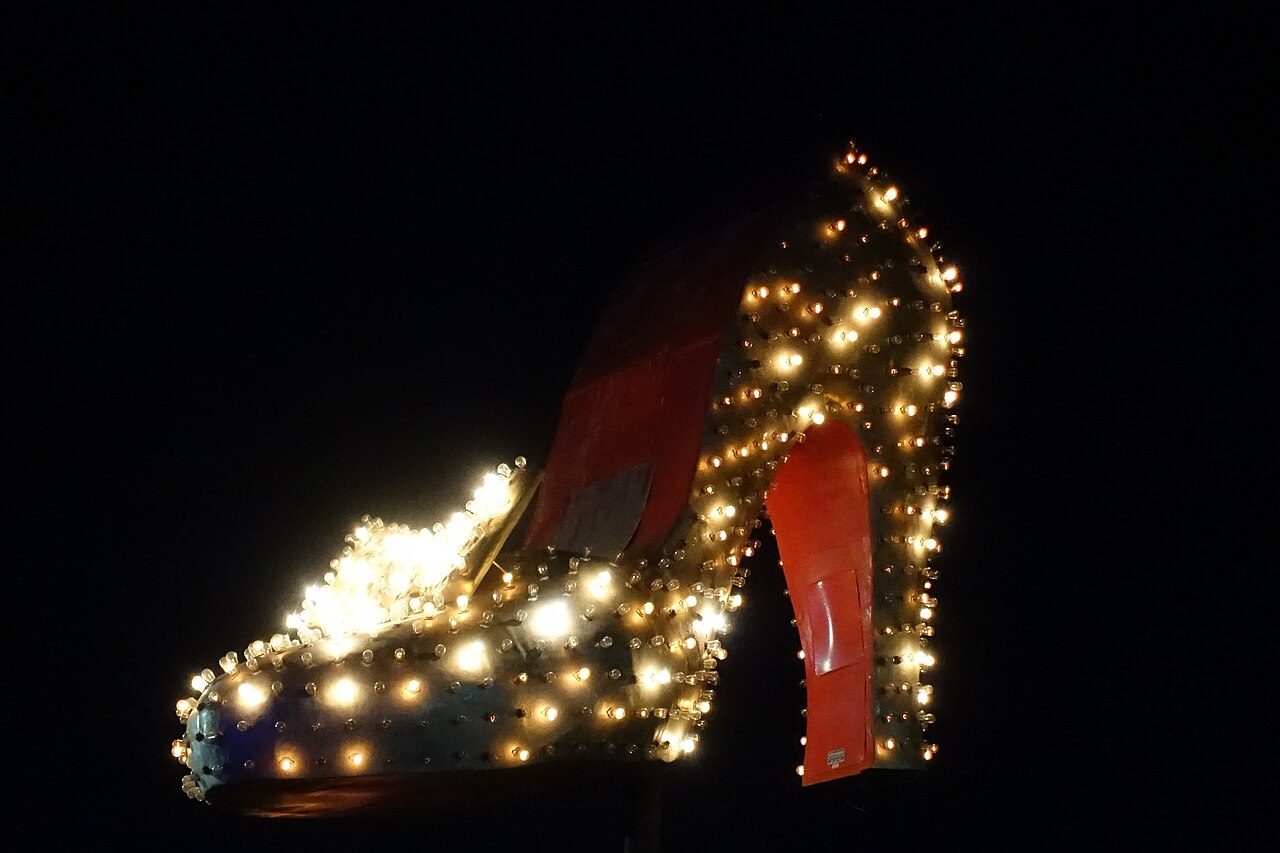

The Silver Slipper opened on the Strip in 1950, next to the Last Frontier, and started life briefly as the Golden Slipper before taking the silver name. Its signature was a giant woman's shoe.
The slipper was designed by Jack Larsen Sr. and built by the Young Electric Sign Company, and it went up in the mid-1950s. According to the Neon Museum, it was silver, gold and blue in the 1950s; a red sole and insole were added in the early 1960s. Reports describe it as about 12 feet (3.7 m) tall, with hundreds of bulbs, and it spun on its mount. It began on the roof and later moved to a pole by the road.
Its neighbor, the Last Frontier, later the New Frontier and then the Frontier, shared the Slipper's early ownership, and the two sat side by side on the Strip for decades. The slipper was one of the more whimsical signs of its era: no lettering needed, just a single object that anyone driving by would remember. That kind of picture sign, also seen in Vegas Vic and the Hacienda horse, was a Las Vegas specialty before the age of giant pylons.
Howard Hughes took control of the casino in 1968, during his buying spree on the Strip. The Silver Slipper closed in November 1988 and was demolished soon after. The slipper went back to YESCO and from there to the Neon Museum.
In 2009, after Las Vegas Boulevard was named a National Scenic Byway, the museum restored the shoe and placed it in the median of Las Vegas Boulevard North, outside its own campus, as one of several restored signs along the road. In 2018 it was repainted in its original blue after staff studied photos from the 1950s and 1960s.
This is one of the few classic signs you can see lit without a ticket. It is right on the street, so look at it from the sidewalk rather than stepping into traffic. It is best after dark, when the bulbs outline the shoe against the sky; by day you can see the blue and red paintwork more clearly.
What to look for
- The heel and the curve of the toe outlined in bulbs.
- The blue paint, restored in 2018 to match photos from the 1950s and 1960s.
- Its position in the median just west of the Neon Museum entrance.
- Other restored signs along the same stretch of the Boulevard, part of the museum's outdoor gallery.
Timeline
- 1950The casino opens as the Golden Slipper and soon becomes the Silver Slipper.
- mid-1950sYESCO builds the slipper sign (1954 or 1955 by different accounts). uncertain
- 1968Howard Hughes takes over the casino's operations.
- 1988The Silver Slipper closes in November.
- 2009Restored and installed in the Las Vegas Blvd North median by the Neon Museum.
- 2018Repainted in its original blue.
Sources
- The Neon Museum: Las Vegas Boulevard Scenic Byway project
- KSNV News 3: Neon Museum restores Silver Slipper sign (2018)
- KTNV: Iconic sign in downtown Las Vegas back to original color
- Wikipedia: Silver Slipper (Las Vegas)
- Wikipedia: Neon Museum
Uncertain or disputed
- Designer Jack Larsen Sr.: Wikipedia and a Historical Marker Database entry (hmdb.org returned 403 to our bot, so only its search snippet was seen).
- Size (about 12 feet, roughly 900 bulbs) and spinning: Wikipedia only; text says 'reports describe'.
- Date of the sign: 1954 or 1955 (Wikipedia), c. 1955 (YESCO), 'c. 1950s' (Neon Museum).
- The story that Hughes had the sign moved because its light kept him awake is anecdotal and left out.
- Shared early ownership with the Last Frontier is from Wikipedia only.
- The KTNV article places it between Sahara and Washington avenues; KSNV says between Bonanza and Washington. Text says 'in front of the Neon Museum'.