
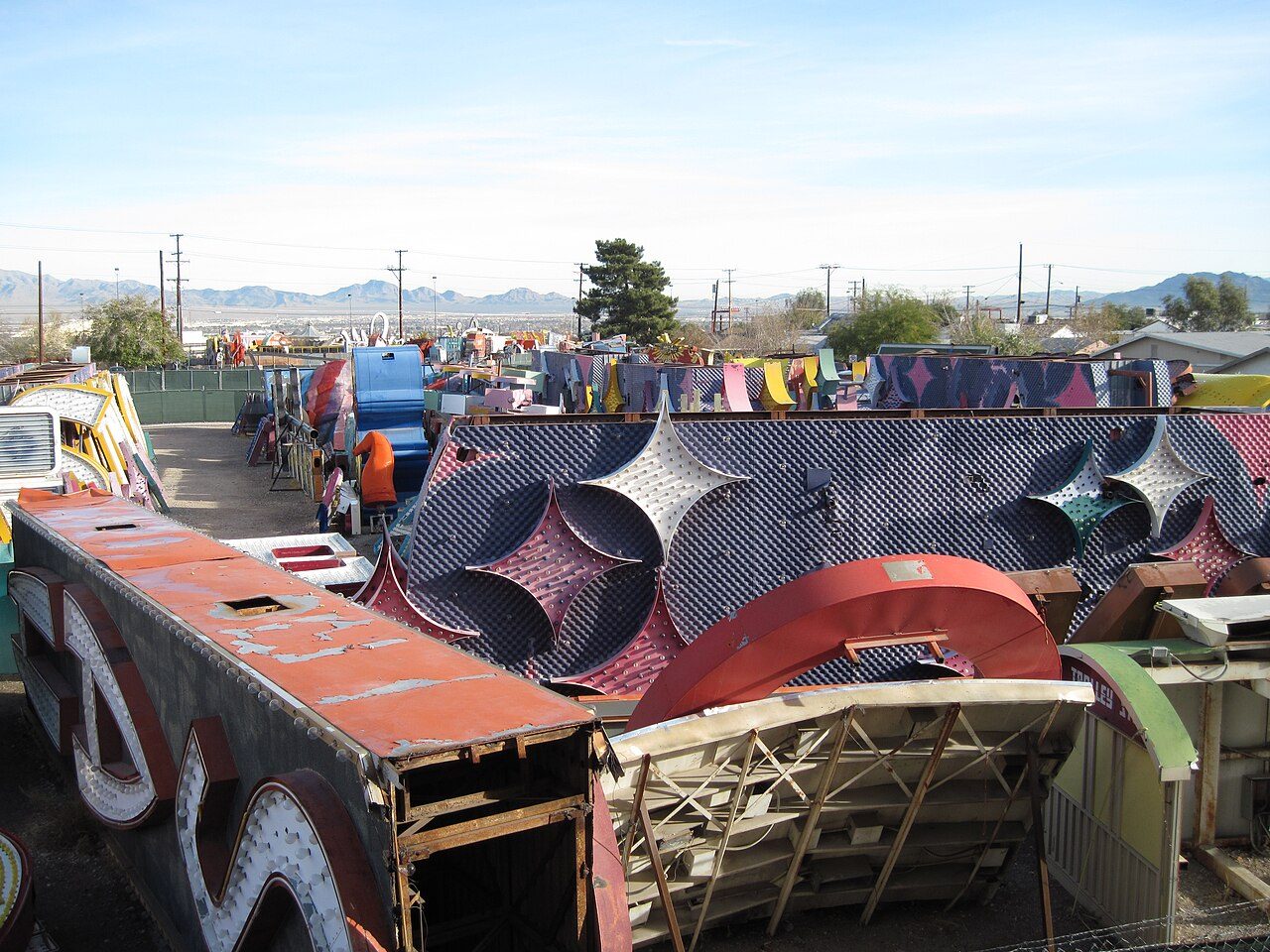

For decades, when a Las Vegas casino replaced its sign, the old one was hauled off to the sign company's yard. The Neon Museum grew out of that habit. In the late 1980s and early 1990s a group of local arts advocates began collecting signs, and in 1996 the City of Las Vegas put up money to turn the effort into a museum. Its first public act, in November 1996, was to relight the Hacienda's Horse and Rider at the corner of Las Vegas Boulevard and Fremont Street.
The collection needed somewhere to live. The city gave the museum a lot on North Las Vegas Boulevard in 2000, and from 2001 the Young Electric Sign Company (YESCO), which had built and stored many of the city's signs, began moving pieces there. That lot became the Neon Boneyard. For years it could be seen only by appointment.
In 2006 the museum acquired the lobby of the La Concha Motel, a swooping concrete shell from 1961, and moved it up the Boulevard from the Strip. Restored as a visitor center, it marked the museum's opening to the general public on October 27, 2012.
The Boneyard today holds more than 250 unrestored signs, lit from the ground at night, plus 32 restored signs that are kept lit. You will find letters, arrows, stars and whole characters from casinos and motels, among them the Stardust, the Riviera, Fitzgeralds and the El Cortez, alongside newer arrivals such as signage from the Mirage, which closed in 2024. A smaller North Gallery next door hosts Brilliant!, a projection show that brings dark, unrestored signs back to animated life.
The museum's reach also extends beyond its fence. Since 2009, when Las Vegas Boulevard was named a National Scenic Byway, it has restored signs for outdoor display along the road, a group it calls the Las Vegas Signs Project. Alongside the Hacienda horse and the Silver Slipper, the list includes small-business signs such as Society Cleaners, from 1946, and the Normandie Motel's hatchet-shaped sign, which the museum attributes to Betty Willis, designer of the 'Welcome to Fabulous Las Vegas' sign. They are lit at night and free to see from the sidewalk.
Visits are by timed ticket, and guided tours are the classic way to see it. Tickets, tour types and hours are all on the official site, neonmuseum.org; check there before you go, since tours can sell out. The museum has been planning a move to a larger downtown site since 2024, so details may change.
What to look for
- The La Concha lobby's scalloped concrete roof at the entrance, designed by architect Paul Revere Williams.
- The giant Stardust letters, relit with bulbs since 2020.
- Signs that came from motels, laundries and small businesses, not just casinos: a reminder that the whole city was lit, not only the resorts.
- Restored signs standing free outside the Boneyard on the Boulevard medians, such as the Silver Slipper, which you can see without a ticket.
Timeline
- 1996City funding approved; the Hacienda Horse and Rider is relit as the first restoration.
- 2001YESCO begins moving signs to the museum's lot, the Neon Boneyard.
- 2006The La Concha Motel lobby is moved to the site.
- 2012The museum opens to the general public on October 27.
- 2018The Brilliant! projection show opens in the North Gallery.
- 2020The Stardust letters are re-lamped and lit daily.
- 2024Mirage signage is donated after the resort closes; relocation plans announced.
Sources
- The Neon Museum (official site)
- The Neon Museum: Neon Boneyard
- The Neon Museum: La Concha Visitors' Center
- Culture Type: Neon Museum marks 10 years at current site (2022)
- KSNV News 3: Stardust sign partially restored (2020)
- Casino.org: Three new Vegas sites contend to house relocated Neon Museum
- Wikipedia: Neon Museum
- Wikipedia: The Mirage
Uncertain or disputed
- Relocation: a 2024 plan for the Arts District was dropped in 2025 and other downtown sites were under consideration; no new site confirmed as of October 2026.
- The 'more than 250 unrestored signs' figure is the museum's own current count; the number of restored signs changes as pieces are added.