
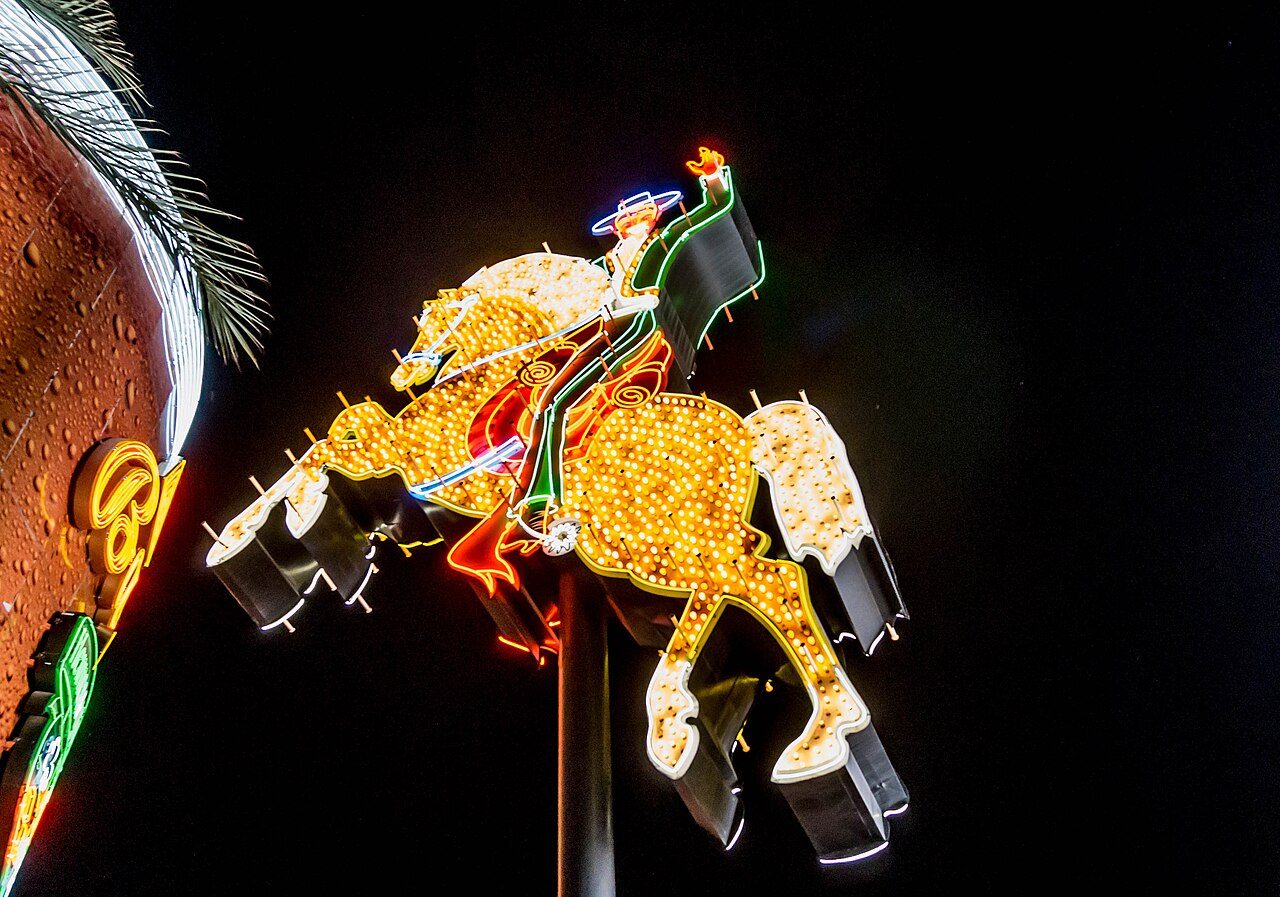

The Hacienda opened at the far south end of the Strip in 1956, a ranch-themed resort on the site where Mandalay Bay stands today. Its best-known sign, a cowboy on a rearing horse, was made by the Young Electric Sign Company in 1967. The Neon Museum says it was commissioned by Judy Bayley, who ran the resort after her husband, Warren 'Doc' Bayley, died in 1964.
The Hacienda closed on December 1, 1996 and was imploded on New Year's Eve that year, on live television. By then the horse and rider had already been saved. It became the Neon Museum's first project: refurbished for about $60,000 and relit on November 13, 1996, at the corner of Las Vegas Boulevard and Fremont Street.
The museum behind that relighting had been years in the making. A group of local arts advocates had been working toward a home for old signs since the late 1980s, and in September 1996 the Las Vegas City Council approved $150,000 in redevelopment money to establish the museum. The horse and rider was its first public result, two months later, and for several years it was the most visible proof that the project existed. The museum would not open its Boneyard to the general public until 2012, sixteen years later.
That makes it a good starting point for a neon walk. It is the sign that turned a group of collectors into a museum, and it set the pattern that followed: rather than keep every restored sign behind a fence, the museum placed several along Las Vegas Boulevard where anyone driving or walking by can see them lit.
The sign was made to be read from a car on the old highway, so it works best from a little distance: stand back on the sidewalk and the horse and rider resolve into one bold silhouette.
The rider has been known to get seasonal makeovers, such as a headless horseman look for Halloween, so do not be surprised if he looks different on your visit. The intersection is busy, with traffic coming off the Boulevard, so use the crosswalks and take your photos from the corners.
What to look for
- The horse-and-rider silhouette, best seen from a few steps back.
- The sign's corner spot at the eastern end of Fremont Street, where the canopy meets Las Vegas Boulevard.
- The view up Las Vegas Boulevard toward the Neon Museum, less than a mile north.
- Other restored museum signs further north along the Boulevard, such as the Silver Slipper.
Timeline
- 1956The Hacienda opens on the south Strip.
- 1967YESCO builds the horse and rider sign.
- 1996Restored and relit at Las Vegas Blvd and Fremont St (November 13); the Hacienda closes and is imploded on December 31.
- 1999Mandalay Bay opens on the former Hacienda site.
Sources
- The Neon Museum: Las Vegas Boulevard Scenic Byway project
- Wikipedia: Neon Museum
- Wikipedia: Hacienda (Las Vegas)
- Vital Vegas / Casino.org: Headless Hacienda horseman
Uncertain or disputed
- Designer: one source (Vintage Las Vegas) credits Brian 'Buzz' Leming Sr.; not confirmed elsewhere, so left null.
- Sign date: the Neon Museum gives 1967; some sources say mid-1960s, and Wikipedia cites a 1965 article about a 'new sign'.
- The story that the horse was modeled on Judy Bayley's own horse is single-sourced and left out.
- Exact position: described as 'at the corner' / 'in the median' of Las Vegas Blvd and Fremont St by different sources.